Books on Rope Making
Making Rope With a Hand-Operated Rope Machine
This book explains the process for making common lay three or four-strand twist rope with a hand-operated rope machine. Different style rope machines are described, along with the rope tool and traveler hook needed to create a working setup for making a rope. Separate chapters are devoted to the rope tool and traveler options. Other chapters focus on design considerations for the rope and how to form it. New material has been added to the chapter detailing how to lay up the yarn (string, twine, etc.) to form the strands of the rope. The layup process has been extended to detail how to incorporate a ring or link into the end of the rope during the layup process.
This book identifies the rest of the parts needed in conjunction with the rope machine for making rope—many parts you already may have. It all depends on the rope length and diameter you are interested in making. Scale your operation up or down as desired. Whether using thread to make scale cordage for model boats or heavy yarns to make inch-thick rope, this book describes the process of making the rope.
Before the early 1800s, all rope was made per the methods shown in this book. Rope making gave way to machinery as the Industrial Revolution developed. The farmers in the American Midwest used these portable, hand-cranked machines to make replacement rope for their barn's hay hoist. Placing hay on the upper floor of the barn was critical to winter survival for the farm animals. Therefore, storing the harvested hay became a time-critical activity when the cut grass had sufficiently dried but before any rain occurred. If the hoist rope broke, then it had to be replaced or repaired immediately to keep harvesting on track. The farmer and his family could use a rope machine to convert available binder twine and make a replacement 140-foot or longer, inch diameter rope in less time than one might ride horseback to the town to acquire a replacement rope.
Title: Making Rope With a Hand Operated Rope Machine, Second Edition, by Greg Davis, now 107 pages in 8.5 by 5.5-inch format, 59 figures, 5 tables. It is softbound.
- Sample of the book: Chapter 1 is an overview of making rope.
- Credit card orders for this book can be made through the www.etsy.com listing for this book.
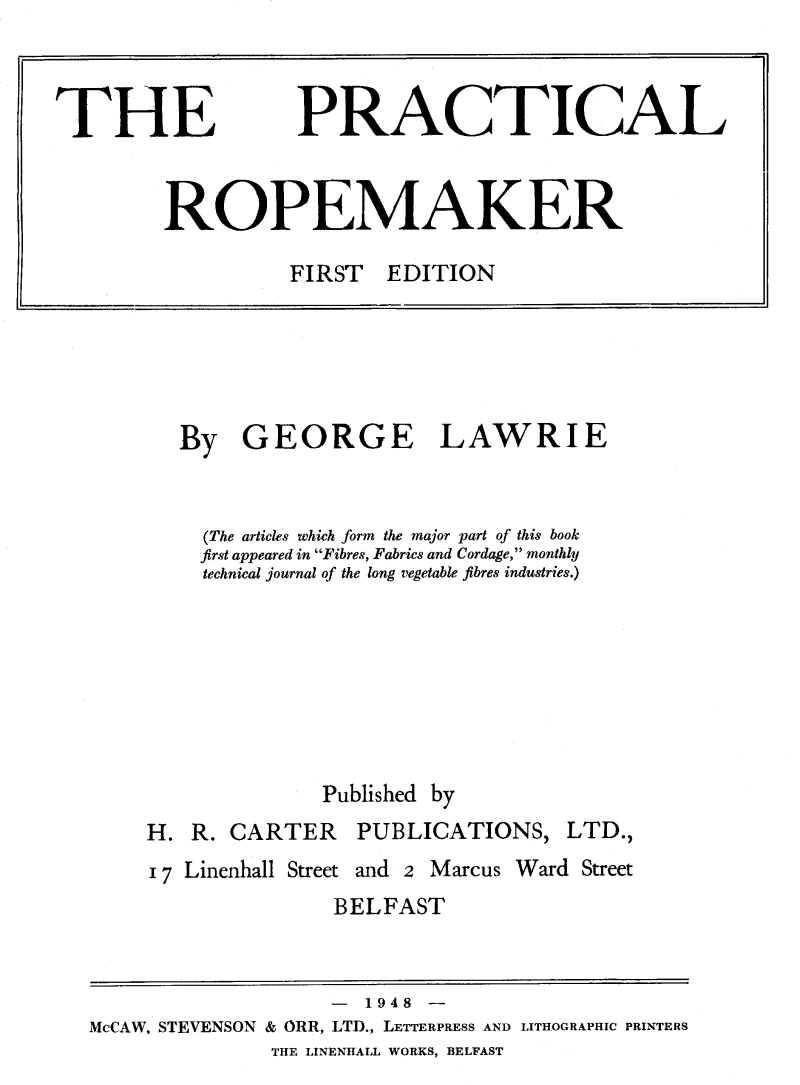
The Practical Ropemaker by George Lawrie
The reprint of George Lawrie's The Practical Ropemaker is now available. It was published by H. R. Carter Publications in Belfast, (North) Ireland, in 1948.
This book documents the commercial vegetable (manila, sisal, etc.) fiber rope manufacturing operations of the era, from fiber processing to spinning, manufacturing cordage, packaging, etc. It contains numerous figures, calculations, pictures, and tables. The glossary of rope terms and products covers 22 pages. Read Chapter 1 in the pdf file.
The book has 123 pages, in 8.5 by 11-inch format, down slightly from the original A4 page format. It is softbound.
Read it to get a feel of the rope making industry of that era. The equipment shown is the predecessor to the automated machinery used today. The calculations, glossary, and some of the reference tables would still be applicable. This is a good historical book for the engineer-minded person. It is referenced in Himmelfarb's book published in the mid-50s.
This is not a practical book for learning to make rope.